


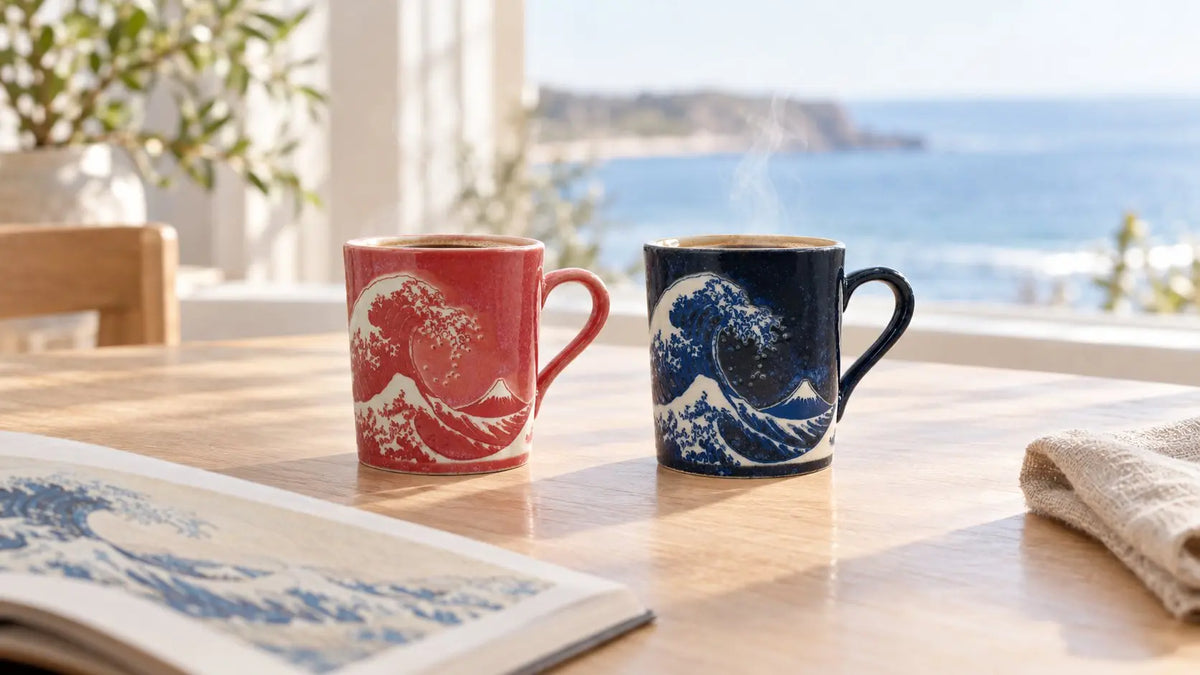
Hokusai Great Wave Homeware
Shop homeware featuring Hokusai's The Great Wave off Kanagawa, one of the most famous artworks in the world. Our Great Wave collection includes the Kanagawa Great Wave Mug in red or blue, the Great Wave Blue Mug Gift Set, rice bowls from $15, 10-inch dinner plates, the Soho Hokusai Wave yunomi tea cup and the Hokusai Great Wave & Red Fuji Bowl Set With Chopsticks.
Most pieces are Mino ware from Gifu Prefecture, made for everyday use.
Read The Great Wave off Kanagawa: Meaning and History, or see our Mt Fuji homeware. Shipping is free Australia-wide on orders over $100.


The Great Wave, on things you actually use
Katsushika Hokusai printed The Great Wave off Kanagawa around 1831, as part of his Thirty-Six Views of Mount Fuji. Nearly two centuries later it's among the most reproduced images in the world — usually as a poster. This range puts it where it started: on objects made in Japan, for daily use.
You'll see it two ways here. Some pieces carry the full composition — the Mino ware plates reproduce the wave with Fuji small in the distance, finished with a warm brown rim. Others take the wave motif alone, as with the Kanagawa mugs and rice bowls, where the pattern wraps the form rather than sitting on it as a picture.
The Great Wave
Hokusai's 1831 woodblock print. Three boats caught beneath a breaking wave, with Mt Fuji small on the horizon.
Kanagawa Okinamiura
The Japanese name our suppliers use for the same scene — the offing at Kanagawa, where the wave was set.
Raised glaze work
The bowl set uses water-repellent glazing so the design sits slightly proud of the surface. You can feel it.
Frequently Asked Questions
These are Japanese-made ceramics inspired by Hokusai's print, which has been in the public domain for well over a century. They're functional tableware, not art prints.
It's the Japanese name for the scene — roughly, the offing at Kanagawa. It refers to the same work known in English as The Great Wave.
Yes. The Mino ware plates, mugs and rice bowls are made for regular use, and most are microwave and dishwasher safe — check the individual product page.
The Kanagawa mug, rice bowl and 10-inch plate share the same motif and colourway, so they build into a coordinated setting. Red and blue are both available.
The larger plate works well on a stand, and plenty of customers buy it for display rather than dining.