

Atelier Yu Cats in a Sunny Spot: A Guide to the Kutani Range

Atelier Yu Cats in a Sunny Spot: A Guide to the Kutani Range
Who Atelier Yu are, and why the cats keep coming back
Kutani ware has always been painter's pottery rather than potter's pottery. It comes from Ishikawa in western Japan, where kilns have been firing since the 1600s, and what made it famous was never the shape of the vessel but what was painted onto it: dense colour, confident line work, and a willingness to put a whole scene where other traditions would settle for a pattern. Atelier Yu work squarely in that tradition, and the Cats in a Sunny Spot scene is the one our customers keep coming back for. A few cats stretched out in a patch of afternoon light, drawn in warm ochres, soft greens and quiet blues, painted individually onto every piece by hand. It started with a single mug. It is now a full table.
The mug, and where the range began
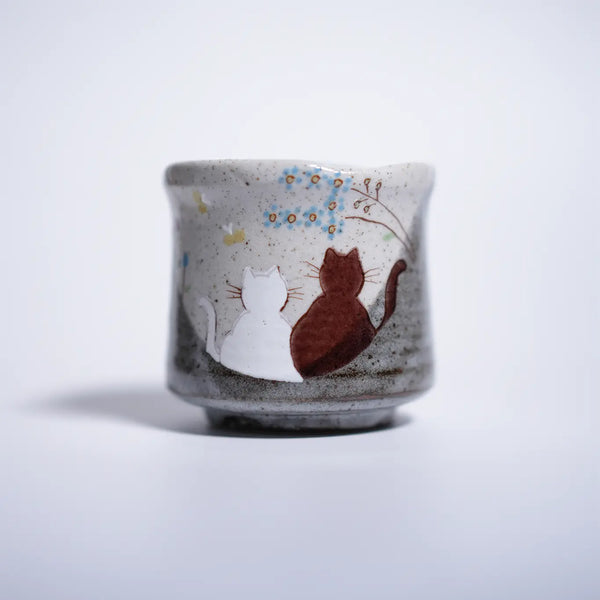
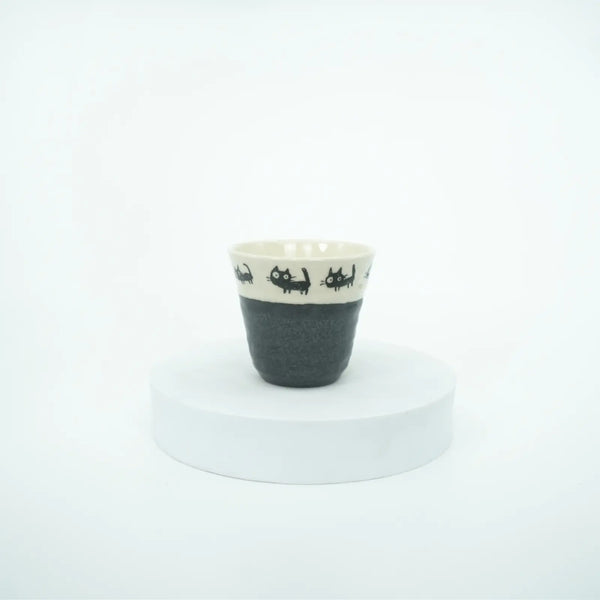
The Cats in a Sunny Spot mug is the piece most people meet first, and it is still the one we sell most of. It works because the scene wraps far enough around the body that the cats come into view as you turn it, so it rewards being used rather than displayed. If you prefer a cup without a handle, the matching tea cup carries the same painting in a shape meant to be cradled in both palms, which suits green tea better than coffee and turns a ten-minute break into something closer to a ritual.

Choosing between the teapot and the yunomi pair
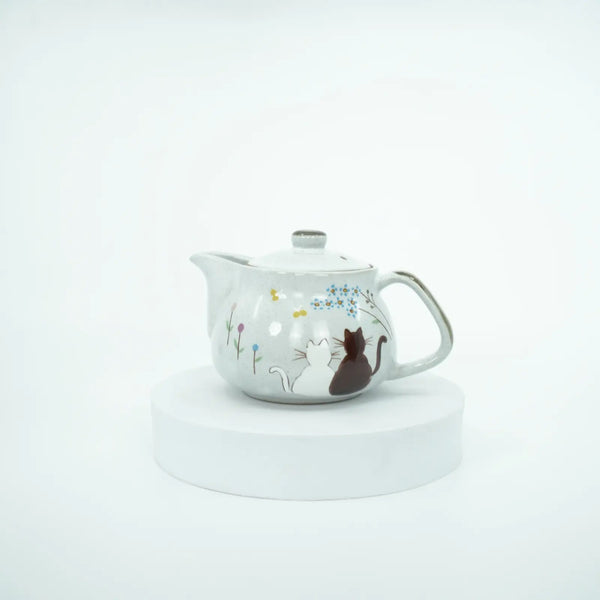
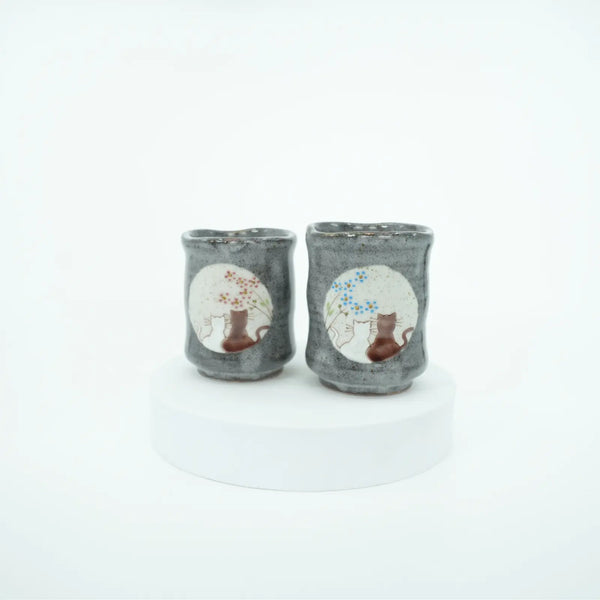
These two are the heart of the range and they answer different questions. The 360ml teapot pours two to three cups, which is the right volume for a slow morning alone or an afternoon pot shared with one other person, and it handles sencha, hojicha and everyday black tea equally well. The yunomi tea cup pair follows the Japanese meoto tradition, where one cup is deliberately larger than the other: 7.5cm across and 9cm tall for the larger, 6.5cm across and 8.5cm tall for the smaller. That pairing is why the set reads so naturally as a wedding, anniversary or housewarming gift in Japan, where two cups of different sizes are a quiet way of saying a home holds two people. Buy the teapot if you are the one making the tea. Buy the pair if you are giving it to a couple. Buy both if you want the table to match.
Taking the scene to the table
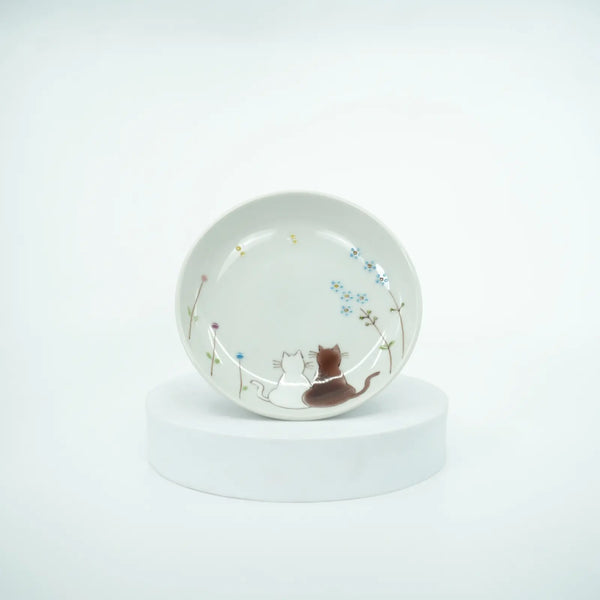
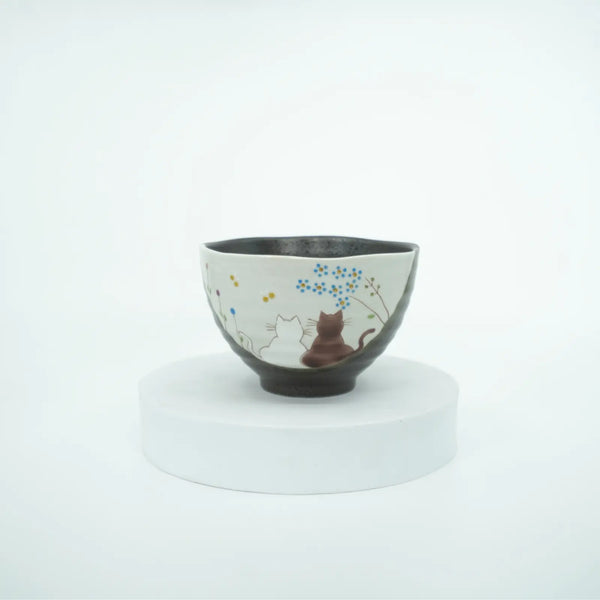
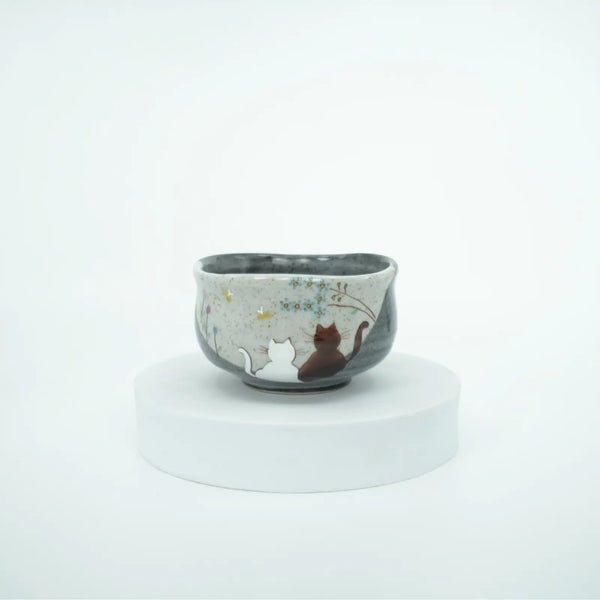
Three pieces carry the cats beyond drinkware. The 14cm small plate sits between a side plate and a saucer, which makes it right for cake, toast, a few pieces of wagashi beside a cup of tea, or the keys and rings that collect by the door, and because it is porcelain rather than stoneware the colours read sharper on it than anywhere else in the range. The rice bowl is 12cm across and 8cm deep, generous enough to double as a small donburi bowl, with enough wall thickness to keep rice warm. The matcha bowl is the specialist of the group at 11cm across and 6.7cm deep, with the open, wide-mouthed chawan shape that gives a bamboo whisk room to move and foam room to build, and thick walls that hold the heat while you drink.
Why no two pieces are identical
Every piece in this range is painted by hand, which means the depth of the colour and the weight of each line shift slightly from one piece to the next. A cat on your teapot will not sit at precisely the same angle as the cat on somebody else's. Pinholes in the glaze, fine crazing and the occasional dark iron speck are characteristic of the material rather than faults in it. This is the difference between hand-finished Kutani and a printed transfer, and it is the reason a set built piece by piece over several months still looks like a set, but never looks mass-produced.
How to build the set
Most people start with the mug and add from there, and there is no wrong order, but there is a sensible one. If tea is already part of your day, the teapot and the yunomi pair are the natural second and third purchases, because they turn a single cup into something you can serve to somebody else. If you eat more often than you brew, the rice bowl and small plate do more work. The matcha bowl is worth buying only if you actually whisk matcha, since its shape is built for that job. Everything arrives gift boxed, which means any single piece stands on its own as a present without extra wrapping, and we include free gift wrapping on request with free shipping on Australian orders over $100.
Frequently Asked Questions
Kutani ware is a style of Japanese porcelain from Ishikawa Prefecture, produced since the 1600s and known for bold overglaze colour and detailed hand-painted scenes. It is distinguished from other Japanese ceramics by the painting rather than the form, which is why a Kutani piece usually carries a full picture rather than a repeating pattern. You can see the full range in our Kutani ware collection.
These are hand-painted pieces, so we recommend hand washing to protect the decoration. If you want a cat design that stands up to daily dishwasher and microwave use, our Mino ware cat pieces are a better fit, and you can find them in the Japanese Cat Mugs and Gifts collection.
Yes. Every piece in the range is sold individually and arrives in its own gift box, so you can build the set over time or give one piece on its own without it looking incomplete.
For a couple, the yunomi tea cup pair, because the meoto pairing carries meaning that a single cup cannot. For someone who already takes tea seriously, the teapot. For a housewarming where you do not know the person's habits well, the small plate is the safest choice, since it is useful to everyone and is the least expensive way into the range.